
Plant Nutrient Processing
A Systems Approach to Availability, Stress, and Failure
Access determines everything. Most plant nutrition problems are not caused by a lack of nutrients, but by a breakdown in the system that makes those nutrients available, accessible, and usable. Soil chemistry, biology, physical structure, and environmental conditions interact to determine what a plant can actually take up. This presentation approaches plant nutrition as a processing system rather than a static inventory, focusing on how and why that system fails.
- 1. What You Will Learn
- 2. Availabillity vs. Presence 🧩
- 3. Chemical Constraints 🧩
- 4. Biological Mediation
- 5. Abiotic Constraints 🧩
- 6. Diagnostic Framework
- 7. Misinterpreting Symptoms
- 8. Stress to Failure 🧩
What You Will Learn
Plant nutrition is not determined by what is present in the soil, but by what a plant can access. Availability is controlled by interacting chemical, biological, physical, and environmental processes.
This presentation introduces a systems-based framework for understanding how nutrients become available, how that process fails, and how those failures appear in plants.

Core Concepts and Framing
Plant nutrition is often presented as a list of nutrients and their functions. This is necessary, but incomplete. Plants respond not to what is present, but to what they can access. Understanding plant nutrition requires understanding the systems that control that access.
Presence Does Not Guarantee Availability
- Nutrients can exist in the soil but be:
- Chemically unavailable (locked in insoluble forms)
- Biologically inaccessible (not yet mineralized)
- Physically unreachable (limited by water or root access)
- Soil tests may indicate adequate nutrient levels while plants still show deficiency symptoms
- Availability is a function of conditions, not just content
Plants Take Up Forms, Not Elements
- Plants absorb nutrients in specific ionic or molecular forms, not as raw elements
- Common examples:
- Nitrogen as NO₃⁻ (nitrate) or NH₄⁺ (ammonium)
- Phosphorus as PO₄³⁻ (phosphate)
- If nutrients are not in the correct form, they are effectively unavailable
- Transformation into usable forms often depends on microbial activity and environmental conditions
Availability Is Controlled by Interacting Systems
- Nutrient access is governed by multiple interacting factors:
- Soil chemistry (pH, ion competition, solubility)
- Biology (microbial transformation, nutrient cycling)
- Physical conditions (soil structure, water movement)
- Environment (temperature, seasonal effects)
- These systems operate simultaneously, not independently
- A constraint in any one system can limit overall nutrient availability
Limitation Is Rarely Singular
- Liebig’s Law identifies a single limiting factor, but real systems often involve:
- Multiple simultaneous constraints
- Hidden antagonisms between nutrients
- Interactions between environmental and soil conditions
- Addressing one limitation without understanding others can:
- Fail to correct the problem
- Introduce new imbalances
Key Ideas
- Nutrients do not move from soil to plant by default
- They must be:
- Transformed into usable forms
- Transported to the root zone
- Accessed by the plant
- Access determines everything
Skills and Outcomes
This section focuses on how to apply the concepts introduced. Understanding nutrient systems is only useful if it leads to better diagnosis and better decisions.
Diagnose Problems Using System Reasoning
- Move beyond single-cause explanations toward multi-factor analysis
- Evaluate how:
- Chemistry (pH, nutrient interactions)
- Biology (microbial activity)
- Physical conditions (water, structure)
- Environment (temperature, season)
interact to affect nutrient access - Recognize that symptoms often result from combined constraints, not isolated issues
Distinguish Between Deficiency, Toxicity, and Imbalance
- Deficiency
- True lack of available nutrient
- Toxicity
- Excess concentration interfering with plant function
- Imbalance
- One nutrient affecting the availability or uptake of another
- Understand that:
- Plants can show deficiency symptoms in nutrient-rich soils
- Toxicity and deficiency can occur simultaneously
Interpret Plant Symptoms Mechanistically
- Move beyond memorizing symptom charts
- Use symptoms to infer:
- Where the breakdown is occurring (soil, root zone, plant)
- Whether the issue is related to:
- Mobility
- availability
- environmental constraint
- Connect:
- Leaf position → nutrient mobility
- Pattern → system behavior
Integrate Multiple Data Sources
- Use a structured diagnostic approach combining:
- Visual observation (what you see now)
- Soil analysis (what is present)
- Tissue analysis (what was taken up)
- Water analysis (what is being added)
- Understand that:
- No single data source is sufficient
- True diagnosis comes from integration, not isolation
Key Ideas
- Good plant nutrition decisions come from understanding systems, not reacting to symptoms
- Effective management requires:
- Diagnosing the cause, not just the expression
- Access determines everything
Why This Matters
Plant nutrition decisions are often made quickly and based on visible symptoms or routine practices. This section explains why that approach can lead to ineffective or even harmful outcomes, and why a systems-based understanding is necessary.
Real-World Consequences of Misdiagnosis
- Applying fertilizer without understanding the system can:
- Fail to correct the problem
- Worsen existing imbalances
- Common outcomes include:
- Continued plant decline despite intervention
- Increased input use with diminishing returns
- Misdiagnosis often leads to treating symptoms instead of causes
Nutrient-Rich Soils Can Still Produce Poor Plants
- High soil nutrient levels do not guarantee plant performance
- Nutrients may be:
- Chemically unavailable (pH, fixation)
- Biologically inaccessible (low microbial activity)
- Physically limited (water or root access issues)
- Plants can exhibit:
- Deficiency symptoms in fertile soils
- Poor growth despite adequate inputs
Over-Application Can Create New Problems
- Excess nutrients can:
- Create antagonisms (blocking other nutrients)
- Increase osmotic stress
- Promote imbalanced growth
- High input systems often lead to:
- Greater dependency on continued inputs
- Reduced system resilience over time
System Failures Lead to Stress and Vulnerability
- When nutrient processing breaks down:
- Plants experience physiological stress
- Growth efficiency declines
- Stressed plants are more susceptible to:
- Pests
- Disease
- Environmental extremes
- Nutrient issues rarely occur in isolation—they cascade into broader system failures
Key Ideas
- Incorrect diagnosis leads to incorrect action
- Effective plant nutrition management requires:
- Understanding how the system functions
- Identifying where it is failing
- Fix the system, not just the symptom
Nutrient Availability Is Not Nutrient Presence
Nutrients in the soil exist in many forms, but only a fraction are accessible to plants at any given time. Availability depends on form, location, and timing, not just total concentration.
This section introduces how nutrients become available to plants, why they may remain inaccessible, and how multiple factors interact to control uptake.

- Essential Nutrients
- Nutrient Uptake Forms
- Liebig’s Law
- Concentration vs Toxicity
- Availability
- Limitation
- 🧩 Exercise
Essential Nutrients and Their Roles
Plants require a defined set of essential nutrients, but their roles in plant function differ significantly. Understanding these roles helps explain why deficiencies and imbalances affect plants in specific ways.
Categories of Essential Nutrients
- Macronutrients
- Required in larger quantities
- Include:
- Nitrogen (N), Phosphorus (P), Potassium (K)
- Calcium (Ca), Magnesium (Mg), Sulfur (S)
- Micronutrients
- Required in smaller quantities, but equally essential
- Include:
- Iron (Fe), Manganese (Mn), Zinc (Zn), Copper (Cu), Boron (B), Molybdenum (Mo), Chlorine (Cl), Nickel (Ni)
Functional Roles in the Plant
- Structural roles
- Calcium (Ca), Boron (B), Silicon (Si) contribute to cell wall stability
- Metabolic and enzymatic roles
- Iron (Fe), Manganese (Mn), Zinc (Zn), Copper (Cu), Magnesium (Mg)
- Energy and genetic processes
- Phosphorus (P) involved in energy transfer (ATP) and genetic material
- Osmotic and regulatory roles
- Potassium (K), Sodium (Na), Chloride (Cl) regulate water balance and enzyme activity
Essential vs Beneficial Nutrients
- Essential nutrients
- Required for completion of the plant life cycle
- Cannot be replaced by another element
- Beneficial nutrients
- Not strictly required but improve plant performance under certain conditions
- May:
- Reduce stress
- Improve efficiency of other nutrients
Sources of Nutrients
- Nutrients enter the plant–soil system from multiple sources:
- Soil minerals (parent material)
- Organic matter decomposition
- Irrigation water
- Atmospheric inputs (e.g., nitrogen fixation, sulfur deposition)
- Fertilizers
Key Ideas
- Plants require specific nutrients, but their presence alone does not ensure function
- Nutrients must be:
- In the correct form
- In the correct location
- Available at the correct time
- Availability, not abundance, determines plant response
Forms of Nutrient Uptake
Plants do not absorb nutrients as raw elements. They take them up as specific ionic or molecular forms, and only when those forms are present in the soil solution and accessible to the root system.
Nutrients Are Absorbed as Specific Forms
- Plants absorb nutrients in defined chemical forms, not as elemental substances
- Common examples:
- Nitrogen as NO₃⁻ (nitrate) or NH₄⁺ (ammonium)
- Phosphorus as PO₄³⁻ (phosphate)
- Potassium as K⁺
- If a nutrient is not in the correct form, it is effectively unavailable to the plant
Soil Solution Is the Immediate Source
- Nutrient uptake occurs primarily from the soil solution
- Nutrients must:
- Be dissolved in water
- Be present near the root surface
- Soil particles act as a reservoir, but nutrients must move into solution to be absorbed
Transformation Is Often Required
- Many nutrients are not initially present in plant-available forms
- Conversion depends on:
- Microbial activity (mineralization, nitrification)
- Chemical reactions (solubility, oxidation-reduction)
- Organic and mineral forms must be transformed before uptake
Movement to the Root Is Essential
- Nutrients must physically reach the root through:
- Mass flow (movement with water)
- Diffusion (movement along concentration gradients)
- Limitations in water movement or soil structure can reduce:
- Nutrient transport
- Root access
Root Uptake Is a Controlled Process
- Roots regulate nutrient uptake through:
- Selective transport mechanisms
- Energy-dependent processes
- Uptake is influenced by:
- Root health
- Oxygen availability
- Environmental conditions
Key Ideas
- Plants do not absorb nutrients simply because they are present
- Nutrients must be:
- In the correct form
- In the soil solution
- Transported to the root surface
- Actively taken up by the plant
- Availability depends on successful transformation and delivery
Liebig’s Law and Its Limitations
Liebig’s Law of the Minimum provides a useful starting point for understanding nutrient limitation. However, real soil–plant systems are more complex, and limitation is rarely controlled by a single factor in isolation.
The Law of the Minimum
- Plant growth is limited by the most limiting factor, not the total availability of all resources
- Often illustrated as:
- A “barrel” where the shortest stave determines capacity
- Common applications:
- Identifying a deficient nutrient
- Prioritizing corrective action
Why It Is Useful
- Provides a clear diagnostic starting point
- Helps focus attention on:
- The most immediate constraint
- Supports efficient decision-making when:
- A single, dominant deficiency is present
Why It Is Incomplete
- Real systems often involve:
- Multiple simultaneous limitations
- Interactions between nutrients and environmental conditions
- A plant may be limited by:
- Chemistry and biology
- Nutrient imbalance and physical restriction
- Focusing on one factor alone can:
- Miss underlying causes
- Lead to incomplete solutions
Interactions Between Limiting Factors
- Nutrients can influence each other through:
- Antagonism (one reduces availability of another)
- Synergism (one increases demand for another)
- Environmental factors can modify limitations:
- Temperature affects microbial activity
- Water affects nutrient movement
- Limitations are often interdependent, not independent
From Single Limitation to System Constraints
- Instead of asking:
- “What is the limiting nutrient?”
- A more accurate question is:
- “What combination of factors is limiting access?”
- This shift leads to:
- Better diagnosis
- More effective interventions
Key Ideas
- Liebig’s Law identifies limitation, but not the full system that creates it
- Effective plant nutrition requires:
- Identifying multiple interacting constraints
- Understanding how they influence each other
- Limitation is rarely singular
Concentration vs Toxicity
Nutrients are required within specific ranges. Both insufficient and excessive concentrations can disrupt plant function. Understanding this balance is essential to avoid misdiagnosis and unintended consequences.
Optimal Ranges, Not Maximum Levels
- Each nutrient has an optimal concentration range for plant function
- Below this range:
- Deficiency limits growth
- Above this range:
- Toxicity interferes with physiological processes
- More nutrients do not necessarily improve plant performance
Deficiency and Toxicity Can Coexist
- A plant can experience:
- Deficiency of one nutrient
- While simultaneously experiencing toxicity or excess of another
- Example scenarios:
- Excess potassium reducing magnesium uptake
- High phosphorus interfering with micronutrient availability
- Symptoms may appear conflicting or misleading
Excess Nutrients Can Disrupt Systems
- High concentrations can:
- Create osmotic stress (reducing water uptake)
- Interfere with enzyme activity
- Alter nutrient balance through antagonistic interactions
- Excess inputs often lead to:
- Reduced efficiency
- Increased system instability
Soil Tests vs Plant Response
- Soil tests measure:
- Total or extractable nutrients
- They do not directly measure:
- What the plant is actually taking up
- High soil nutrient levels do not guarantee:
- Adequate plant nutrition
- Interpretation requires understanding:
- Availability, not just concentration
Toxicity Is Context-Dependent
- Toxic effects depend on:
- Soil type
- pH
- Biological activity
- Environmental conditions
- A concentration that is safe in one system may be harmful in another
- Context determines whether a nutrient behaves as:
- Beneficial or harmful
Key Ideas
- Plant nutrition depends on balance, not abundance
- Both deficiency and toxicity result from disrupted availability systems
- Effective management requires maintaining nutrients within:
- The correct range
- The correct relationships
- More is not better. Appropriate is better.
Availability Is Controlled by Interacting Systems
Nutrient availability is not controlled by a single factor. It emerges from the interaction of multiple systems that operate together. Understanding these interactions is essential for diagnosing why nutrients may be present but inaccessible.
Soil Chemistry Determines Form and Solubility
- pH controls nutrient solubility
- Influences whether nutrients are:
- Available in solution
- Bound in insoluble forms
- Ion interactions affect availability
- Nutrients compete for:
- Exchange sites
- Uptake pathways
- Chemical fixation can limit access
- Phosphorus can become bound to:
- Iron and aluminum in acidic soils
- Calcium in alkaline soils
Biology Controls Transformation and Release
- Microorganisms regulate:
- Mineralization (conversion of organic nutrients into plant-available forms)
- Immobilization (temporary storage within microbial biomass)
- The soil food web influences:
- Nutrient cycling rates
- Timing of nutrient release
- Root–microbe interactions affect:
- Availability at the rhizosphere level
Physical Conditions Enable or Limit Movement
- Soil structure affects:
- Porosity and aeration
- Root growth and exploration
- Water availability controls:
- Nutrient movement via mass flow and diffusion
- Compaction can:
- Restrict root access
- Reduce oxygen availability
- Limit microbial activity
Environmental Conditions Set the Boundaries
- Temperature influences:
- Microbial activity
- Enzyme function
- Nutrient transformation rates
- Seasonal effects impact:
- Timing of nutrient availability
- Synchronization with plant demand
- Moisture conditions (drought or saturation) can:
- Limit nutrient transport
- Alter chemical and biological processes
Systems Operate Simultaneously
- Chemistry, biology, physics, and environment:
- Act at the same time, not in sequence
- A constraint in any one system can:
- Limit the effectiveness of the others
- Improvements in one area may:
- Be ineffective if other constraints remain
Key Ideas
- Nutrient availability is an emergent property of interacting systems
- No single factor determines plant access
- Effective diagnosis requires identifying:
- Which system is limiting
- How multiple systems are interacting
- Access determines everything
Limitation Is Rarely Singular
While nutrient problems are often described as single deficiencies, real systems are governed by multiple interacting constraints. Effective diagnosis requires recognizing how these constraints combine to limit plant access.
Multiple Constraints Are Common
- Plants are often limited by:
- More than one factor at the same time
- Examples include:
- Low magnesium availability combined with high potassium levels
- Adequate nutrients present, but limited by poor root access
- A single visible symptom may reflect:
- Several underlying constraints
Interactions Create Hidden Limitations
- Nutrients can influence each other through:
- Antagonism (reducing availability)
- Synergism (increasing demand)
- Environmental factors can intensify limitations:
- Cold soil slowing microbial processes
- Drought limiting nutrient movement
- Some limitations are not directly measurable:
- They emerge from interactions within the system
Addressing One Factor May Not Solve the Problem
- Correcting a single nutrient level may:
- Leave other constraints unresolved
- Fail to improve plant performance
- In some cases, intervention can:
- Create new imbalances
- Shift the limitation elsewhere in the system
System Perspective Improves Diagnosis
- Effective diagnosis requires:
- Identifying all relevant constraints
- Understanding how they interact
- Move from:
- “What is missing?”
→ to - “What is limiting access?”
- This approach leads to:
- More accurate conclusions
- More effective corrective actions
Key Ideas
- Plant growth is limited by interacting constraints, not isolated deficiencies
- Solving nutrient problems requires:
- Identifying multiple limitations
- Understanding their relationships
- The system determines the outcome
Exercise 1: What Do You See? (Visual Diagnosis)
This exercise focuses on observation and initial hypothesis formation. The goal is not to arrive at a single correct answer, but to develop reasoning based on visible evidence.
Scenario
- You are observing a planting where:
- Lower (older) leaves show yellowing (chlorosis)
- Upper (newer) leaves appear relatively healthy
- Growth is somewhat reduced, but not severely stunted
- The soil test (provided verbally or on screen) indicates:
- Adequate overall nutrient levels
Team Task
- As a group, discuss and answer:
- What do you observe?
- Where are the symptoms located?
- Based on location, is this likely:
- A mobile or immobile nutrient issue?
- What are 2–3 possible causes?
- What additional information would you want before making a decision?
Discussion Focus
- Focus on:
- Symptom location (older vs newer leaves)
- The concept that:
- Presence does not guarantee availability
- Avoid jumping directly to:
- A single nutrient conclusion
Example Reasoning
Use this to compare your team’s reasoning, not to replace it.
Key Ideas
- Observation is the starting point, not the conclusion
- Symptom location provides:
- Clues about nutrient mobility
- Multiple causes can produce:
- The same visible pattern
- What you see must be interpreted within the system
Chemical Constraints (pH, CEC, and Ion Competition)
Nutrient availability is strongly controlled by soil chemistry. Even when nutrients are present, chemical conditions determine whether they remain available, become fixed, or compete with one another.
This section examines how pH, cation exchange capacity, and ion interactions regulate nutrient access at the chemical level.

Soil pH as a Master Variable
Soil pH is one of the most influential factors controlling nutrient availability. It affects nutrient solubility, chemical form, and the activity of biological processes that contribute to nutrient cycling.
pH Controls Nutrient Solubility
- Soil pH influences whether nutrients:
- Remain dissolved in the soil solution
- Become insoluble and unavailable
- Most nutrients are optimally available within a moderate pH range
- Extreme pH levels can:
- Limit multiple nutrients simultaneously
Acidic Soil Effects (Low pH)
- Increased availability of:
- Iron (Fe), Manganese (Mn), Zinc (Zn), Copper (Cu)
- Potential risks:
- Toxicity from soluble metals
- Reduced availability of:
- Calcium (Ca), Magnesium (Mg), Molybdenum (Mo)
Alkaline Soil Effects (High pH)
- Reduced availability of:
- Iron (Fe), Manganese (Mn), Zinc (Zn), Copper (Cu)
- Potential outcomes:
- Micronutrient deficiencies despite adequate soil levels
- Increased availability of:
- Molybdenum (Mo)
pH Influences Biological Activity
- Microbial processes are sensitive to pH:
- Mineralization rates
- Nutrient transformations
- Suboptimal pH can:
- Reduce biological contribution to nutrient availability
pH Is a System Selector
- Soil pH does not simply “protect” nutrients
- It selects which nutrients are available and in what form
- Different plants are adapted to:
- Different pH environments
- Optimal pH depends on:
- Plant species and system context
Key Ideas
- pH determines which nutrients are available, not just how much is present
- Incorrect pH can:
- Create both deficiency and toxicity conditions
- Chemical conditions define access
Mulder’s Chart (Antagonisms and Synergisms)
Nutrients do not act independently in the soil or within the plant. Their availability and uptake are influenced by interactions with other nutrients. These relationships can either enhance or restrict access, often in ways that are not immediately visible.
Nutrient Antagonism (Competition)
- Antagonism occurs when one nutrient reduces the availability or uptake of another
- Common mechanisms:
- Competition for exchange sites in the soil
- Competition for uptake pathways in the root
- Examples:
- High potassium (K⁺) reducing uptake of magnesium (Mg²⁺) and calcium (Ca²⁺)
- Excess phosphorus (P) reducing availability of micronutrients such as zinc (Zn)
- Antagonism can lead to:
- Deficiency symptoms despite adequate soil levels
Nutrient Synergism (Interaction)
- Synergism occurs when one nutrient enhances the uptake or effectiveness of another
- These relationships often support:
- Metabolic processes
- Structural development
- Examples:
- Nitrogen (N) and sulfur (S) working together in protein formation
- Balanced nutrient availability supporting overall plant function
- Synergism highlights the importance of:
- Balanced nutrient systems, not isolated additions
Ion Competition in Soil and Root Systems
- Nutrients compete at multiple levels:
- Soil exchange sites (CEC)
- Root surface transport systems
- Cations (positively charged ions) such as:
- Ca²⁺, Mg²⁺, K⁺, NH₄⁺
compete directly with one another - High concentration of one ion can:
- Displace others from exchange sites
- Reduce their uptake by roots
Interactions Can Be Hidden
- Soil tests may show:
- Adequate levels of multiple nutrients
- However:
- Interactions can prevent those nutrients from being accessible
- Symptoms may reflect:
- Interaction effects rather than true absence
- Without understanding these relationships:
- Diagnosis may be incorrect
Managing Nutrient Interactions
- Effective management requires:
- Maintaining balanced nutrient ratios
- Avoiding excessive application of any single nutrient
- Adjustments should consider:
- Whole-system effects, not isolated corrections
- Over-application can:
- Shift the system into new imbalances
Key Ideas
- Nutrients interact, compete, and influence each other continuously
- Availability is shaped by:
- Relationships between nutrients, not just their individual levels
- Balance determines access
Ion Pecking Order and Competition
Not all nutrients compete equally. In soil systems, ions follow a general hierarchy that influences which nutrients dominate exchange sites and uptake pathways. This hierarchy helps explain why some nutrients consistently displace others.
Cation Exchange Sites and Charge Dynamics
- Soil particles (clay and organic matter) carry negative charges
- These sites attract and hold cations (positively charged ions)
- Common cations include:
- Calcium (Ca²⁺), Magnesium (Mg²⁺), Potassium (K⁺), Sodium (Na⁺), Ammonium (NH₄⁺)
- These ions are held:
- Temporarily on exchange sites
- In equilibrium with the soil solution
Ion Strength and Competitive Advantage
- Ions differ in their ability to:
- Attach to exchange sites
- Displace other ions
- General competitive hierarchy (simplified):
- Al³⁺ ≈ H⁺ > Ca²⁺ > Mg²⁺ > K⁺ ≈ NH₄⁺ > Na⁺
- Higher charge and smaller hydrated radius generally:
- Increase competitive strength
- Stronger ions can:
- Displace weaker ions from exchange sites
Displacement and Availability
- When dominant ions increase in concentration:
- They can displace other nutrients into the soil solution
- This can lead to:
- Increased availability (temporary)
- Or increased leaching losses
- Example:
- High potassium levels displacing magnesium, leading to deficiency
Soil Solution vs Exchange Pool
- Nutrients exist in two main pools:
- Exchange pool (held on soil particles)
- Soil solution (available for immediate uptake)
- Exchange sites act as:
- A buffer system, replenishing the soil solution
- Imbalance in the exchange pool can:
- Distort what is available in solution
Management Implications
- Adding one nutrient affects others:
- Due to displacement and competition
- Fertilization strategies should:
- Consider relative proportions, not just absolute amounts
- Overloading one ion can:
- Reduce availability of others
- Create cascading imbalances
Key Ideas
- Not all nutrients compete equally—some dominate the system
- Ion hierarchy influences:
- Which nutrients are held
- Which are displaced
- Which are available for uptake
- Competition determines access at the chemical level
Cation Exchange Capacity (CEC)
Cation Exchange Capacity (CEC) describes the soil’s ability to hold and exchange positively charged nutrients. It functions as a buffer and reservoir, regulating nutrient availability over time.
What CEC Represents
- CEC measures the number of negatively charged sites in the soil
- These sites are found on:
- Clay particles
- Organic matter (humus)
- They attract and hold cations such as:
- Ca²⁺, Mg²⁺, K⁺, NH₄⁺, Na⁺
- Higher CEC means:
- Greater capacity to retain nutrients
High vs Low CEC Soils
- High CEC soils
- Typically rich in clay and/or organic matter
- Characteristics:
- Greater nutrient holding capacity
- More buffering against rapid changes
- Nutrients are:
- Retained longer
- Released more gradually
- Low CEC soils
- Typically sandy or low in organic matter
- Characteristics:
- Limited nutrient holding capacity
- Greater risk of nutrient loss
- Nutrients are:
- More prone to leaching
- Less buffered
CEC as a Nutrient Buffer
- CEC moderates the relationship between:
- Soil solution (immediate availability)
- Exchange sites (stored nutrients)
- When nutrients are removed from solution:
- Exchange sites release additional nutrients
- When excess nutrients are added:
- Exchange sites can temporarily store them
Influence of Soil Composition
- CEC depends on:
- Clay type and quantity
- Organic matter content
- Organic matter is particularly important because:
- It contributes significantly to CEC
- It enhances both chemical and biological function
Interaction with pH and Ion Competition
- CEC does not act independently:
- It interacts with pH and ion hierarchy
- Changes in pH can:
- Alter charge characteristics
- Influence how strongly nutrients are held
- Ion competition determines:
- Which nutrients occupy exchange sites
Key Ideas
- CEC determines the soil’s ability to store and supply nutrients over time
- It acts as a buffer between:
- Immediate availability and long-term supply
- Effective nutrient management depends on:
- Understanding both capacity and balance
- Storage and exchange regulate access
Exercise 2: When Nutrients Compete
This exercise focuses on nutrient interactions and chemical constraints. The goal is to understand how nutrients can be present but unavailable due to competition, imbalance, or pH effects.
Scenario
- A crop is showing:
- Interveinal chlorosis on older leaves
- Overall growth is moderately reduced
- Soil test results indicate:
- High potassium (K)
- Adequate magnesium (Mg)
- pH is within an acceptable range
- No obvious signs of:
- Water stress
- Physical compaction
Team Task
- As a group, discuss and answer:
- What do you observe?
- Based on symptom location, which nutrient category is implicated?
- Does the soil test suggest:
- A deficiency
- Or a possible interaction effect?
- What is a likely explanation for the observed symptoms?
- What would you recommend:
- Investigating next
- Or adjusting in management?
Discussion Focus
- Focus on:
- Ion competition and antagonism
- The idea that:
- High levels of one nutrient can reduce availability of another
- Connect to:
- Mulder’s Chart
- Cation competition (K⁺ vs Mg²⁺)
Example Reasoning
Use this to compare your team’s reasoning, not to replace it.
Key Ideas
- Nutrients can limit each other through competition and imbalance
- Soil tests showing “adequate” levels do not guarantee:
- Effective uptake
- Diagnosis must consider:
- Interactions, not just concentrations
- Balance determines access
Biological Mediation (Soil Food Web and Rhizosphere)
Nutrient availability is not controlled by chemistry alone. Soil organisms regulate how nutrients are transformed, released, and delivered to plants. Biological activity determines when and how nutrients become available.
This section examines how the soil food web and root–microbe interactions mediate nutrient access within the soil–plant system.
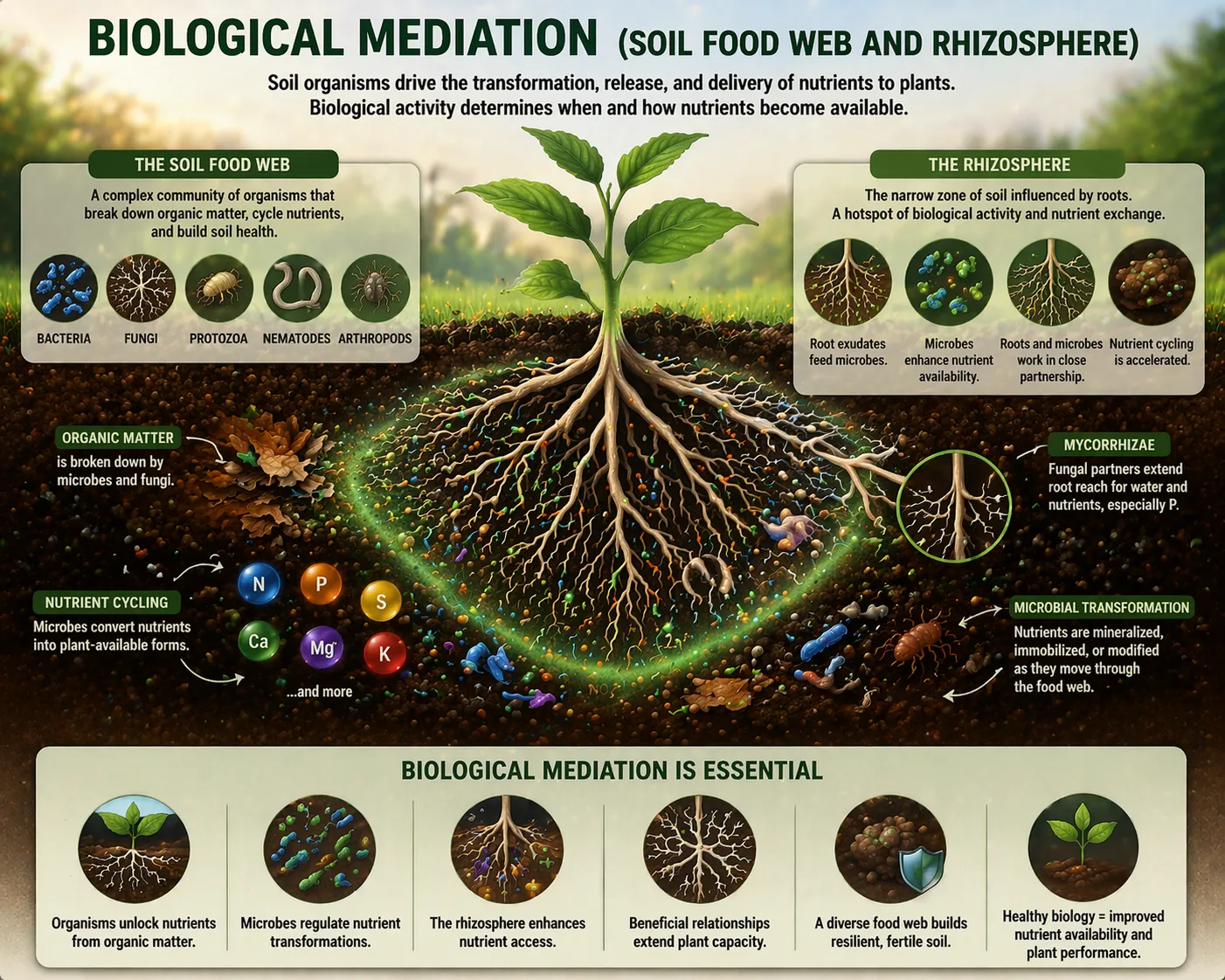
Soil Food Web Structure
Soil is not an inert medium. It is a living biological system composed of interacting organisms that drive nutrient cycling, energy flow, and soil structure. Understanding this community is essential to understanding how nutrients become available.
Major Groups in the Soil Food Web
- Soil contains a diverse community of organisms, including:
- Bacteria
- Fungi
- Protozoa
- Nematodes
- Arthropods and earthworms
- Each group plays a distinct role in:
- Decomposition
- Nutrient transformation
- Soil structure development
Functional Roles of Organisms
- Bacteria
- Rapidly decompose simple organic materials
- Drive early stages of nutrient cycling
- Fungi
- Break down complex organic matter (e.g., lignin)
- Contribute to soil aggregation and structure
- Protozoa and nematodes
- Feed on bacteria and fungi
- Release nutrients in plant-available forms through grazing
- Arthropods and earthworms
- Fragment organic material
- Improve soil structure and aeration
Energy Flow Through the System
- The soil food web is driven by carbon inputs, primarily from:
- Plant residues
- Root exudates
- Energy flows through:
- Decomposers → grazers → higher-level organisms
- Nutrient release is linked to:
- biological consumption and turnover
Nutrient Cycling Through Biological Activity
- Nutrients are continuously:
- Immobilized (taken up by organisms)
- Mineralized (released into plant-available forms)
- Grazing activity accelerates:
- Nutrient release into the soil solution
- The timing of availability depends on:
- Biological activity levels
Structure Emerges From Biology
- Soil structure is influenced by:
- Fungal hyphae binding particles
- Organic matter decomposition
- Biological aggregation processes
- A well-structured soil:
- Supports root growth
- Enhances water and nutrient movement
Key Ideas
- Soil organisms are not passive—they actively control nutrient availability
- Nutrients are released through:
- Biological processes, not just chemical reactions
- The soil food web regulates when and how nutrients become available
Microbial Control of Nutrient Availability
Microorganisms regulate the transformation, storage, and release of nutrients in soil. They determine when nutrients become available, and in what form, often controlling access more directly than soil chemistry alone.
Mineralization: Converting to Plant-Available Forms
- Microbes convert organic nutrients into inorganic, plant-available forms
- Examples:
- Organic nitrogen → NH₄⁺ (ammonium) → NO₃⁻ (nitrate)
- Organic phosphorus → PO₄³⁻ (phosphate)
- This process is driven by:
- Microbial metabolism
- Environmental conditions (temperature, moisture)
- Without mineralization:
- Nutrients remain unavailable despite being present
Immobilization: Temporary Nutrient Storage
- Microorganisms take up nutrients into their biomass:
- Temporarily removing them from plant availability
- Occurs when:
- Carbon is abundant relative to nitrogen (high C:N ratio)
- Immobilization is not loss:
- It is short-term storage within the biological system
- Nutrients are later released:
- When microbes die or are consumed
Microbial Turnover Releases Nutrients
- Nutrient release is often driven by:
- Predation and grazing (protozoa, nematodes)
- When microbes are consumed:
- Excess nutrients are released into the soil solution
- This creates a cycle of:
- Uptake → storage → release
- Timing depends on:
- Activity of the soil food web
Microbes Modify Nutrient Forms
- Microbial processes influence:
- Oxidation–reduction reactions
- Nutrient solubility
- Examples:
- Nitrification and denitrification
- Phosphorus solubilization
- These transformations determine:
- Whether nutrients are accessible or lost
Biological Activity Is Environment-Dependent
- Microbial function depends on:
- Temperature
- Moisture
- Oxygen availability
- Under unfavorable conditions:
- Nutrient cycling slows or stops
- This can lead to:
- Temporary nutrient deficiency despite adequate reserves
Key Ideas
- Microorganisms control the timing and form of nutrient availability
- Nutrients move through a cycle of:
- Transformation → storage → release
- Plant access depends on:
- Active, functioning biological systems
- Biology determines when nutrients become usable
Rhizosphere Economy
The rhizosphere is the narrow zone of soil directly influenced by plant roots. It is a highly active exchange environment where plants and microorganisms interact continuously. Nutrient availability in this zone is shaped by biological trade, not passive supply.
Root Exudates as Biological Currency
- Plants release compounds into the soil, including:
- Sugars
- Amino acids
- Organic acids
- These exudates serve as:
- Energy sources for microbes
- In return, microbes:
- Enhance nutrient availability
- This creates a system of:
- Exchange rather than extraction
Plants Influence Their Microbial Community
- Root exudates shape:
- The composition of microbial populations
- Plants can encourage:
- Beneficial organisms that support nutrient access
- Different plant species:
- Support different microbial communities
- The rhizosphere is:
- A managed environment, not a random one
Nutrient Access Is Localized
- Nutrient availability is often highest:
- In the immediate vicinity of roots
- Microbial activity concentrates:
- Around root surfaces
- This creates a gradient:
- High activity near roots
- Lower activity further away
- Root architecture influences:
- The extent of this active zone
Cooperation and Competition Coexist
- The rhizosphere includes:
- Mutualistic relationships (plant–microbe cooperation)
- Competitive interactions (microbes competing for resources)
- Not all interactions are beneficial:
- Some microbes compete with plants for nutrients
- System balance determines:
- Whether interactions are net positive or negative
Root Health Determines System Function
- Healthy roots:
- Maintain active exudation
- Support microbial communities
- Stressed or damaged roots:
- Reduce exudate production
- Disrupt biological interactions
- Root conditions directly affect:
- Nutrient access efficiency
Key Ideas
- Nutrient availability in the rhizosphere is driven by biological exchange
- Plants actively influence their environment through:
- Exudates and root activity
- Nutrient access is:
- Local, dynamic, and biologically mediated
- Access is negotiated, not given
Mycorrhizae and Nutrient Extension
Mycorrhizal fungi form symbiotic relationships with plant roots, extending the effective reach of the root system. These associations significantly enhance nutrient and water access, especially in nutrient-limited environments.
Fungal Networks Extend Root Reach
- Mycorrhizal fungi form hyphal networks that extend beyond root surfaces
- These networks explore soil volumes:
- Inaccessible to roots alone
- Hyphae are:
- Thinner than roots
- Able to penetrate smaller soil pores
- This effectively increases:
- The plant’s absorptive surface area
Enhanced Nutrient Acquisition
- Mycorrhizae are particularly effective at acquiring:
- Phosphorus (P)
- Micronutrients such as zinc (Zn) and copper (Cu)
- Fungi access nutrients:
- From soil zones beyond root depletion areas
- Nutrients are transported:
- From fungal networks to plant roots
Exchange Relationship Between Plant and Fungi
- Plants supply fungi with:
- Carbon (photosynthates)
- Fungi supply plants with:
- Nutrients and water
- This is a mutualistic exchange:
- Both organisms benefit
- The relationship depends on:
- Active plant photosynthesis and healthy roots
Role in Stress Tolerance
- Mycorrhizal associations improve plant resilience to:
- Drought (enhanced water uptake)
- Nutrient-poor soils
- They can also contribute to:
- Improved soil aggregation
- Greater system stability
Sensitivity to Disturbance
- Mycorrhizal networks can be disrupted by:
- Soil disturbance (e.g., tillage)
- Excessive fertilizer inputs
- Chemical treatments
- When disrupted:
- Nutrient acquisition efficiency declines
- Recovery may require:
- Time and favorable conditions
Key Ideas
- Mycorrhizae extend the plant’s ability to access nutrients beyond the root zone
- Nutrient uptake is not limited to root surface area alone
- Symbiotic relationships increase:
- Efficiency
- Resilience
- Biological partnerships expand access
Physical and Environmental Constraints
Nutrient availability depends not only on chemistry and biology, but also on the physical environment in which roots and microbes operate. Water, temperature, soil structure, and seasonal conditions determine whether nutrients can move, transform, and be accessed by plants.
This section examines how physical and environmental factors enable or limit nutrient uptake within the soil–plant system.

Water as a Transport Medium
Water is the primary medium through which nutrients move in the soil. Without sufficient water, nutrients cannot reach plant roots, regardless of how much is present. Nutrient availability depends on movement, and movement depends on water.
Mass Flow: Nutrients Move With Water
- Nutrients are transported toward roots through mass flow
- Driven by:
- Plant water uptake (transpiration)
- As roots absorb water:
- Dissolved nutrients move with it
- Particularly important for:
- Nitrogen (NO₃⁻)
- Calcium (Ca²⁺)
- Magnesium (Mg²⁺)
Diffusion: Movement Along Concentration Gradients
- Nutrients also move by diffusion:
- From areas of high concentration to low concentration
- Occurs near the root surface where:
- Nutrients are depleted by uptake
- Especially important for:
- Phosphorus (P)
- Potassium (K⁺)
- Diffusion is slower than mass flow:
- Strongly influenced by soil moisture
Water Availability Limits Nutrient Movement
- In dry soils:
- Nutrient movement slows or stops
- Diffusion distances increase
- Even if nutrients are present:
- They may not reach the root surface
- Drought conditions often result in:
- Functional nutrient deficiencies
Excess Water Can Also Limit Access
- Saturated soils reduce:
- Oxygen availability
- This affects:
- Root respiration
- Microbial activity
- Can lead to:
- Reduced nutrient uptake
- Altered nutrient forms (e.g., denitrification)
Soil Moisture Balance Is Critical
- Optimal nutrient movement requires:
- Balanced soil moisture
- Too little water:
- Limits transport
- Too much water:
- Limits oxygen and root function
- Both extremes reduce:
- Effective nutrient availability
Key Ideas
- Water is the transport system for nutrients in soil
- Nutrient availability depends on:
- Movement toward the root
- Without adequate water:
- Nutrients remain inaccessible
- No movement means no access
Temperature and Seasonal Effects
Temperature and seasonal conditions regulate the rates of biological, chemical, and physical processes in soil. Even when nutrients are present, low or extreme temperatures can limit the plant’s ability to access and use them.
Temperature Controls Biological Activity
- Microbial processes are strongly temperature-dependent:
- Mineralization slows in cold soils
- Nutrient cycling accelerates in warm conditions
- Low temperatures reduce:
- Microbial metabolism
- Nutrient release into plant-available forms
- Warm temperatures increase activity:
- But only within optimal ranges
Root Function Is Temperature-Sensitive
- Root growth and function decline in:
- Cold soils
- Reduced root activity leads to:
- Lower nutrient uptake rates
- Even if nutrients are available:
- Plants may be unable to absorb them effectively
Seasonal Mismatch Between Supply and Demand
- Nutrient availability and plant demand do not always align
- Early season conditions:
- Cool soils → slow nutrient release
- Rapid plant demand → potential deficiency
- Late season conditions:
- Nutrients may be available when plant demand declines
- Timing affects:
- Efficiency of nutrient use
Temperature Influences Chemical Processes
- Reaction rates increase with temperature:
- Affecting nutrient solubility and transformation
- Cold conditions can:
- Slow chemical reactions
- Reduce nutrient availability
- Extreme heat can:
- Disrupt biological and chemical balance
Environmental Stress Alters Nutrient Use
- Temperature stress can:
- Reduce plant metabolic efficiency
- Alter nutrient requirements
- Plants under stress may:
- Use nutrients less efficiently
- Exhibit symptoms unrelated to true deficiency
Key Ideas
- Temperature regulates the rate at which nutrients become available and usable
- Nutrient availability is not constant:
- It changes with environmental conditions
- Timing is critical:
- Availability must align with plant demand
- Environment determines when access is possible
Soil Structure and Compaction
Soil structure determines how air, water, roots, and organisms move through the soil. When structure is degraded or compacted, nutrient movement, root access, and biological activity are all restricted.
Soil Structure Defines Pore Space
- Soil is composed of:
- Solid particles (sand, silt, clay)
- Pore spaces (air and water-filled voids)
- Good structure creates:
- A balance of large pores (aeration, drainage)
- And small pores (water retention)
- This balance supports:
- Root growth
- Microbial activity
- Nutrient movement
Compaction Reduces Functionality
- Compaction occurs when:
- Soil particles are pressed closer together
- Results include:
- Reduced pore space
- Limited air and water movement
- Compacted soils restrict:
- Root penetration
- Gas exchange
- Nutrient transport
Oxygen Availability Is Critical
- Roots and microbes require:
- Oxygen for respiration
- Poorly structured or compacted soils can become:
- Oxygen-limited
- Low oxygen conditions reduce:
- Root function
- Microbial activity
- This limits:
- Nutrient uptake and transformation
Structure Influences Water Movement
- Well-structured soils:
- Allow efficient water infiltration and distribution
- Compacted soils:
- Promote runoff or waterlogging
- Both extremes reduce:
- Effective nutrient transport
- Water movement and structure are:
- Closely linked
Biology Builds Structure
- Soil structure is not purely physical:
- It is influenced by biological activity
- Fungi, roots, and organic matter:
- Help bind soil particles into aggregates
- Loss of biological activity leads to:
- Structural degradation
- Increased susceptibility to compaction
Key Ideas
- Soil structure controls the physical pathways for nutrient movement and root access
- Compaction limits:
- Air, water, and biological function
- Without proper structure:
- Nutrients cannot move effectively
- Structure enables access
Environmental Extremes
Plants do not operate under constant conditions. Environmental extremes such as drought, saturation, heat, cold, and atmospheric factors can disrupt nutrient availability and plant function. These conditions often override both chemical and biological processes.
Drought Limits Nutrient Access
- Low soil moisture reduces:
- Mass flow (nutrient movement with water)
- Diffusion (movement toward roots)
- Nutrients may be present but:
- Unable to reach the root surface
- Drought conditions often result in:
- Functional nutrient deficiencies
- Root growth may also be restricted:
- Further limiting access
Saturation Reduces Oxygen and Function
- Excess water fills pore spaces:
- Displacing oxygen
- Low oxygen conditions affect:
- Root respiration
- Microbial activity
- Can lead to:
- Reduced nutrient uptake
- Changes in nutrient form (e.g., nitrogen loss through denitrification)
Heat Stress Alters System Balance
- High temperatures increase:
- Biological activity (up to a point)
- Beyond optimal ranges:
- Enzyme function declines
- Microbial balance may shift
- Plants under heat stress:
- May struggle to maintain nutrient uptake
- Can exhibit stress symptoms unrelated to deficiency
Cold Conditions Slow All Processes
- Low temperatures reduce:
- Microbial activity
- Chemical reaction rates
- Root growth and function
- Nutrients remain in the soil:
- But are released and taken up more slowly
- Early-season deficiencies are often:
- Driven by temperature, not absence
Light and Wind Influence Plant Demand and Transport
- Light (solar radiation) drives photosynthesis
- Determines the plant’s energy supply
- Controls production of:
- Sugars
- Root exudates
- Low light conditions:
- Reduce nutrient demand
- Reduce root activity and uptake
- High light increases nutrient demand
- Faster growth requires:
- Increased nutrient uptake
- If supply does not match demand:
- Deficiency symptoms can appear
Wind influences transpiration
- Increases water loss from leaves
- Drives mass flow of nutrients toward roots
- Moderate wind can:
- Enhance nutrient movement
- Excessive wind can:
- Increase plant stress
- Lead to water limitation, reducing nutrient uptake
- Wind Interaction with water availability
- High wind + low soil moisture:
- Reduces water uptake
- Limits nutrient transport
- Environmental factors often interact:
- Not act independently
Adaptation vs Limitation
- Different plants are adapted to:
- Different environmental conditions
- What is limiting in one system:
- May be normal in another
- Management must consider:
- Plant adaptation
- Environmental context
Key Ideas
- Environmental conditions can override nutrient availability
- Light controls demand, and wind influences transport
- Even well-balanced systems can fail under:
- Extreme conditions
- Nutrient access depends on:
- Conditions that allow movement, transformation, and uptake
- Environment sets the limits of access
Exercise 3: When the System Limits Access
This exercise focuses on situations where nutrients are present, but physical and biological conditions prevent access. The goal is to identify constraints that are not visible in standard nutrient measurements.
Scenario
- A planting shows:
- General chlorosis across the field
- Reduced growth and uneven vigor
- Soil test results indicate:
- Nutrient levels are generally adequate
- pH is within an acceptable range
- Field observations reveal:
- Soil is dense and difficult to penetrate
- After rainfall, water tends to:
- Pool in some areas
- Drain slowly
- Recent conditions:
- Periods of heavy rain followed by warm temperatures
Team Task
- As a group, discuss and answer:
- What do you observe beyond nutrient levels?
- Which system(s) may be limiting:
- Chemical
- Biological
- Physical
- Environmental
- How might soil conditions be affecting:
- Root growth
- Water movement
- Oxygen availability
- Why might nutrients be present but not accessible?
- What would you investigate or change first?
Discussion Focus
- Focus on:
- Soil structure and compaction
- Water saturation and oxygen limitation
- The relationship between:
- Physical conditions → biological activity → nutrient availability
- Reinforce that:
- Multiple constraints can act simultaneously
Example Reasoning
Use this to compare your team’s reasoning, not to replace it.
Key Idea
- Nutrient availability depends on physical conditions that allow movement and uptake
- Compaction and poor drainage can:
- Limit root function
- Reduce biological activity
- Even with adequate nutrients:
- Access may be restricted
- Structure and environment determine access
Diagnostic Framework (Professional Nutrient Analysis)
Diagnosing nutrient problems requires more than observing symptoms or reviewing a single data source. Effective diagnosis integrates multiple lines of evidence to identify where and why nutrient access is limited.
This section introduces a structured framework used in plant nutrition to evaluate nutrient availability and determine appropriate corrective actions.
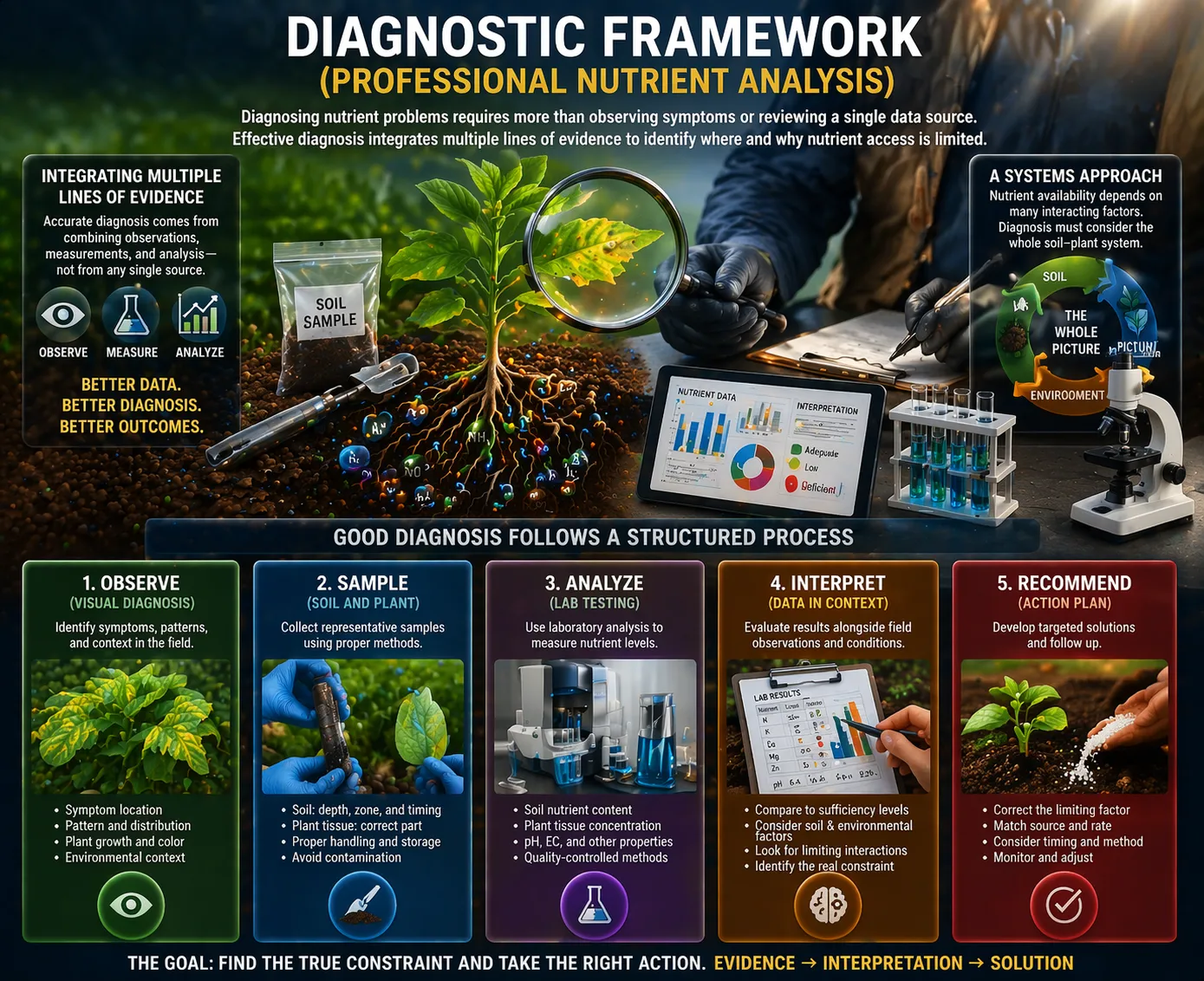
Visual Diagnosis
Visual observation is often the first step in identifying nutrient problems. While symptoms can provide valuable clues, they must be interpreted carefully. Symptoms indicate that a problem exists, but not necessarily what caused it.
Symptoms Reflect Plant Response, Not Cause
- Visible symptoms show:
- How the plant is responding to stress
- They do not directly identify:
- The underlying cause of the problem
- The same symptom can result from:
- Different nutrient issues
- Environmental stress
- Physical or biological limitations
Common Morphological Indicators
- Nutrient-related stress often appears as:
- Chlorosis (yellowing of leaves)
- Necrosis (tissue death)
- Leaf curl or distortion
- Stunted growth
- Patterns of symptoms provide important clues:
- Distribution across the plant
- Severity and progression
Location of Symptoms Matters
- The position of symptoms on the plant helps indicate:
- Nutrient mobility
- Mobile nutrients (e.g., nitrogen, potassium):
- Symptoms appear first on older leaves
- Immobile nutrients (e.g., calcium, iron):
- Symptoms appear first on new growth
- This helps narrow:
- Possible causes
Patterns Across the Field or Planting Area
- Observing spatial patterns can reveal:
- Underlying system issues
- Examples:
- Uniform symptoms → likely systemic issue
- Patchy symptoms → localized problem (soil variability, moisture differences)
- Patterns help distinguish between:
- Soil-related vs environmental causes
Limitations of Visual Diagnosis
- Symptoms can be:
- Misleading or ambiguous
- Multiple issues can produce:
- Similar visual patterns
- Environmental stress can mimic:
- Nutrient deficiencies
- Visual diagnosis alone is:
- Insufficient for accurate conclusions
Key Ideas
- Symptoms reveal that a problem exists, not what caused it
- Visual observation is a starting point:
- Not a final diagnosis
- Accurate interpretation requires:
- Integration with other data
- Observation must lead to investigation
Soil Analysis
Soil analysis provides insight into the chemical and physical conditions that influence nutrient availability. It answers the question: what is present and under what conditions? However, it does not directly indicate what the plant is taking up.
What Soil Tests Measure
- Soil tests typically evaluate:
- pH (acidity or alkalinity)
- Extractable nutrient levels (e.g., P, K, Ca, Mg)
- Cation Exchange Capacity (CEC)
- Organic matter content
- Results represent:
- The potential supply of nutrients
- They do not directly measure:
- Real-time plant uptake
Interpreting Soil Test Results
- Results are often reported as:
- Low, medium, or high categories
- Interpretation depends on:
- Crop type
- Soil characteristics
- Regional guidelines
- High nutrient levels do not guarantee:
- Availability or plant access
Soil Sampling Is Critical
- Accurate results depend on proper sampling:
- Correct depth (root zone)
- Representative locations
- Consistent timing
- Poor sampling can lead to:
- Misleading results
- Variability within a field can:
- Affect interpretation
Soil Tests Reflect Conditions, Not Outcomes
- Soil analysis shows:
- What is present in the soil system
- It does not show:
- What the plant has absorbed
- Limitations include:
- Inability to capture:
- Biological activity
- Real-time environmental effects
Using Soil Analysis Effectively
- Soil tests should be used to:
- Identify potential limitations
- Guide nutrient management decisions
- Best used in combination with:
- Visual observations
- Tissue analysis
- Environmental context
- Interpretation should focus on:
- Availability, not just concentration
Key Ideas
- Soil tests measure potential supply, not actual uptake
- High nutrient levels do not ensure availability
- Accurate interpretation requires:
- Context and integration with other data
- Presence does not equal access
Tissue (Foliar) Analysis
Tissue analysis evaluates the nutrients that have actually been absorbed by the plant. It answers the question: what did the plant take up? This provides a direct measure of nutrient status within the plant, rather than potential availability in the soil.
What Tissue Analysis Measures
- Tissue analysis determines:
- Nutrient concentrations within plant tissues
- Commonly measured nutrients include:
- Macronutrients (N, P, K, Ca, Mg, S)
- Micronutrients (Fe, Mn, Zn, Cu, B, Mo)
- Results reflect:
- The plant’s nutrient status over time
Reflects Actual Uptake
- Unlike soil tests, tissue analysis shows:
- What nutrients the plant has successfully absorbed
- Can reveal:
- Deficiencies not apparent in soil data
- Imbalances affecting plant function
- Helps identify:
- Whether nutrients are truly accessible
Timing and Sampling Are Critical
- Results depend heavily on:
- When samples are taken
- Which plant tissues are selected
- Standard practices include:
- Sampling specific leaves at defined growth stages
- Inconsistent sampling can:
- Lead to misleading conclusions
Interpreting Tissue Results
- Nutrient levels are compared to:
- Established sufficiency ranges
- Interpretation must consider:
- Growth stage
- Environmental conditions
- Results may indicate:
- Deficiency, sufficiency, or excess
Limitations of Tissue Analysis
- Reflects past conditions, not immediate changes
- Does not identify:
- The underlying cause of nutrient issues
- Cannot distinguish whether limitations are due to:
- Soil chemistry
- Biology
- Physical constraints
- Environmental factors
Using Tissue Analysis Effectively
- Most powerful when combined with:
- Soil analysis
- Visual observations
- Helps confirm:
- Whether a suspected deficiency is real
- Supports:
- More precise nutrient management decisions
Key Ideas
- Tissue analysis shows what the plant has actually taken up
- It confirms whether nutrients are accessible in practice
- However, it does not explain:
- Why access is limited
- Uptake reveals outcome, not cause
Water Analysis
Water is not just a transport medium; it is also a source of dissolved minerals and salts that can influence nutrient availability. Water quality affects both the soil environment and plant uptake processes.
What Water Analysis Measures
- Water tests evaluate:
- Electrical conductivity (EC) (total dissolved salts)
- pH
- Alkalinity (bicarbonates and carbonates)
- Individual ions such as:
- Calcium (Ca²⁺), Magnesium (Mg²⁺), Sodium (Na⁺), Chloride (Cl⁻), Sulfate (SO₄²⁻)
- Results indicate:
- The chemical load being added to the system
Water as a Nutrient Source
- Irrigation water can contribute:
- Significant amounts of nutrients over time
- Repeated application can:
- Accumulate nutrients in the soil
- In some cases:
- Water may supply a meaningful portion of plant nutrient needs
Salt Accumulation and Stress
- High EC indicates:
- Elevated salt concentrations
- Excess salts can:
- Reduce water uptake by plants (osmotic stress)
- Interfere with nutrient absorption
- Salt buildup is more likely in:
- Poorly drained soils
- High evaporation conditions
Alkalinity and pH Effects
- High alkalinity water can:
- Gradually increase soil pH
- This can reduce availability of:
- Micronutrients such as iron (Fe), zinc (Zn), and manganese (Mn)
- Long-term irrigation with alkaline water can:
- Shift soil chemistry significantly
Sodium and Soil Structure
- High sodium levels can:
- Disrupt soil structure
- Reduce aggregation
- This leads to:
- Poor infiltration
- Reduced aeration
- Structural degradation further limits:
- Nutrient movement and root access
Using Water Analysis Effectively
- Water quality should be evaluated:
- As part of the overall nutrient system
- Helps identify:
- Hidden sources of nutrients
- Potential long-term changes in soil chemistry
- Should be integrated with:
- Soil and tissue analysis
Key Ideas
- Water influences both nutrient supply and soil conditions
- It can:
- Add nutrients
- Introduce salts
- Alter pH and structure
- Effective diagnosis requires understanding:
- What is being added through water
- Water shapes the system over time
Integrated Diagnosis
No single method can fully explain nutrient problems. Effective diagnosis requires combining multiple sources of information to understand both what is happening and why it is happening. This integrated approach leads to more accurate conclusions and better decisions.
No Single Data Source Is Sufficient
- Each diagnostic tool provides a partial view:
- Visual diagnosis → symptoms
- Soil analysis → potential supply
- Tissue analysis → actual uptake
- Water analysis → ongoing inputs
- Relying on one source alone can:
- Lead to incorrect conclusions
- True diagnosis requires:
- Multiple perspectives
Combining Evidence Improves Accuracy
- Integrating data allows you to:
- Confirm or challenge initial observations
- Example:
- Soil test shows adequate nutrients
- Tissue test shows deficiency
- → Indicates an availability problem, not absence
- Cross-referencing data reveals:
- Hidden constraints
Identify the Limiting System
- Diagnosis should determine:
- Which system is limiting access:
- Chemical (pH, antagonism)
- Biological (low microbial activity)
- Physical (compaction, water limitation)
- Environmental (temperature, seasonal timing)
- Multiple systems may:
- Contribute simultaneously
From Observation to Decision
- Effective diagnosis follows a process:
- Observation → hypothesis → verification → action
- Actions should target:
- The underlying cause, not just symptoms
- This leads to:
- More efficient and effective interventions
Avoiding Common Diagnostic Errors
- Jumping to conclusions based on:
- Single symptoms
- Single test results
- Over-applying nutrients without:
- Understanding system constraints
- Ignoring environmental or physical limitations
Key Ideas
- Accurate diagnosis requires integrating multiple sources of information
- The goal is to identify:
- Where the system is failing
- Why access is limited
- Effective solutions come from:
- Addressing the root cause
- Diagnosis determines action
Plant Symptoms and Misinterpretation
Plant symptoms provide visible evidence that something is wrong, but they do not directly reveal the cause. Similar symptoms can arise from very different underlying issues, including nutrient deficiencies, toxicities, environmental stress, or physical limitations.
This section examines how to interpret plant symptoms accurately while avoiding common misdiagnoses.

Mobile vs Immobile Nutrients
The location of symptoms on a plant provides critical clues about nutrient mobility. Some nutrients can move within the plant, while others cannot. This determines where deficiency symptoms appear first.
What Nutrient Mobility Means
- Nutrient mobility refers to:
- The ability of a nutrient to move from older tissues to newer growth
- When a nutrient is limited:
- Mobile nutrients are relocated within the plant
- Immobile nutrients are not redistributed
Mobile Nutrients Show Symptoms in Older Leaves
- Mobile nutrients can move:
- From older leaves → to new growth
- When deficient:
- Older leaves lose nutrients first
- Common mobile nutrients:
- Nitrogen (N)
- Phosphorus (P)
- Potassium (K)
- Magnesium (Mg)
- Additional mobile nutrients (less commonly emphasized):
- Chlorine (Cl) (generally mobile in plants)
- Molybdenum (Mo) (high mobility, though rarely deficient)
- Typical symptoms:
- Yellowing or decline in lower, older leaves
Immobile Nutrients Show Symptoms in New Growth
- Immobile nutrients cannot move:
- Once deposited in plant tissue
- When deficient:
- New growth is affected first
- Common immobile nutrients:
- Calcium (Ca)
- Iron (Fe)
- Boron (B)
- Additional immobile nutrients (less commonly emphasized):
- Copper (Cu)
- Manganese (Mn)
- Zinc (Zn)
- Nickel (Ni) (required in very small amounts)
- Typical symptoms:
- Distortion, chlorosis, or poor development in young leaves or growing tips
Intermediate or Context-Dependent Mobility
- Some nutrients do not fit cleanly into one category:
- Their mobility can vary depending on:
- Plant species
- Environmental conditions
- Nutrient status
- Intermediate mobility nutrients:
- Sulfur (S) (limited mobility; often behaves like immobile)
- These nutrients may show:
- Symptoms in both older and newer tissues
- Interpretation requires:
- Additional context
Complete Set of Essential Nutrients (Reference)
- The 17 essential nutrients are:
- Carbon (C), Hydrogen (H), Oxygen (O) (from air and water)
- Nitrogen (N), Phosphorus (P), Potassium (K)
- Calcium (Ca), Magnesium (Mg), Sulfur (S)
- Iron (Fe), Manganese (Mn), Zinc (Zn), Copper (Cu)
- Boron (B), Molybdenum (Mo), Chlorine (Cl), Nickel (Ni)
- Mobility-based grouping applies primarily to:
- Nutrients taken up from soil

Why This Matters for Diagnosis
- Symptom location helps:
- Narrow down possible nutrient issues
- It provides an early filter for:
- Identifying likely deficiencies
- However:
- It must be used with other information
- Environmental stress can sometimes:
- Mimic these patterns
Key Ideas
- Symptom location reflects nutrient mobility within the plant
- Older leaves → likely mobile nutrient issue
- New growth → likely immobile nutrient issue
- This is a starting point for diagnosis, not a final answer
- Location provides clues, not conclusions
Morphological Indicators
Plant morphology provides visible evidence of stress and dysfunction. Different nutrient issues often produce characteristic patterns, but these patterns must be interpreted carefully. Symptoms describe the plant’s response, not the underlying cause.
Chlorosis (Yellowing of Leaves)
- Chlorosis is the loss of green color due to:
- Reduced chlorophyll production
- Common causes include:
- Nitrogen deficiency (uniform yellowing)
- Iron deficiency (interveinal chlorosis in young leaves)
- Magnesium deficiency (interveinal chlorosis in older leaves)
- Patterns provide clues:
- Uniform chlorosis → often mobile nutrient deficiency
- Interveinal chlorosis → often micronutrient-related
Necrosis (Tissue Death)
- Necrosis appears as:
- Brown, dead tissue on leaves or margins
- Common associations:
- Potassium deficiency (leaf edge burn)
- Severe nutrient imbalances or toxicity
- Often follows:
- Earlier stages of chlorosis
Leaf Curling and Distortion
- Leaves may show:
- Curling, twisting, or abnormal shape
- Common causes:
- Calcium deficiency (affects cell wall formation)
- Boron deficiency (affects growing points)
- Also influenced by:
- Environmental stress (heat, water imbalance)
Stunted Growth and Reduced Vigor
- Plants may exhibit:
- Slowed growth
- Smaller leaves
- Reduced biomass
- Often linked to:
- Nitrogen deficiency
- Root system limitations
- Poor overall nutrient access
Pattern and Distribution Matter
- Symptoms should be evaluated based on:
- Location on the plant (mobility clues)
- Uniformity across the field or area
- Examples:
- Uniform symptoms → systemic issue
- Patchy symptoms → localized constraint
Symptoms Can Overlap
- Different nutrient issues can produce:
- Similar visual symptoms
- Environmental stress can:
- Mimic nutrient deficiencies
- Multiple issues can occur:
- At the same time
Key Ideas
- Morphological symptoms reflect how the plant is responding to stress
- Similar symptoms can result from:
- Different causes
- Accurate interpretation requires:
- Context and supporting data
- What you see is a signal, not a diagnosis
Deficiency vs Toxicity Confusion
Deficiency and toxicity are often treated as opposites, but in practice they can produce similar or overlapping symptoms. Misinterpreting one as the other can lead to corrective actions that worsen the problem.
Deficiency and Toxicity Can Look Similar
- Both conditions can produce:
- Chlorosis (yellowing)
- Necrosis (leaf damage)
- Reduced growth
- Visual symptoms alone often:
- Cannot distinguish between too little and too much
- Example:
- Leaf burn may result from:
- Potassium deficiency
- Salt toxicity
Excess Nutrients Can Cause Functional Deficiencies
- High levels of one nutrient can:
- Interfere with uptake of others
- This creates:
- Antagonistic effects
- Examples:
- Excess potassium (K⁺) reducing magnesium (Mg²⁺) uptake
- Excess phosphorus (P) reducing zinc (Zn) availability
- The plant may show:
- Deficiency symptoms despite adequate or excessive supply
Toxicity Directly Disrupts Plant Function
- Excess nutrients can:
- Interfere with enzyme activity
- Disrupt cellular processes
- Create osmotic stress
- High salt concentrations can:
- Reduce water uptake
- Mimic drought conditions
Context Determines Interpretation
- Interpretation depends on:
- Soil test results
- Tissue analysis
- Environmental conditions
- The same visual symptom may have:
- Different causes in different systems
- Without context:
- Diagnosis is unreliable
Overcorrection Can Worsen the Problem
- Misdiagnosing toxicity as deficiency may lead to:
- Additional nutrient application
- This can:
- Increase imbalance
- Intensify plant stress
- Correct diagnosis is essential before:
- Taking action
Key Ideas
- Deficiency and toxicity are not always visually distinct
- Excess nutrients can create:
- Functional deficiencies
- Accurate diagnosis requires:
- Understanding nutrient interactions and context
- More input can worsen the problem if the cause is misunderstood
Sampling and Observation Accuracy
Accurate diagnosis depends on accurate observation and sampling. Errors in how data are collected can lead to incorrect conclusions, even when analytical methods are sound. Poor sampling produces misleading results.
Representative Sampling Is Essential
- Samples must reflect the true condition of the system
- Avoid:
- Sampling only the most damaged plants
- Sampling only the healthiest plants
- Select samples that represent:
- The overall condition of the area
- When variability exists:
- Sample multiple locations
Proper Tissue Selection Matters
- Use standardized plant parts:
- Specific leaves or growth stages
- Avoid:
- Severely damaged or dead tissue
- Follow established guidelines for:
- Crop type and growth stage
- Incorrect tissue selection can:
- Distort results
Timing Affects Interpretation
- Sampling time influences:
- Nutrient concentrations
- Factors include:
- Time of day
- Growth stage
- Environmental conditions
- Consistent timing improves:
- Comparability of results
Field Observations Should Be Systematic
- Observe patterns across:
- The entire field or planting area
- Look for:
- Uniform vs patchy symptoms
- Associations with:
- Soil type
- Moisture conditions
- Landscape position
- Record observations:
- Before drawing conclusions
Avoid Bias in Observation
- Preconceptions can influence:
- What is noticed and how it is interpreted
- Avoid:
- Jumping to conclusions based on prior experience alone
- Use observation as:
- A starting point for investigation
Key Ideas
- Accurate diagnosis depends on accurate sampling and observation
- Poor sampling leads to:
- Misleading data
- Reliable conclusions require:
- Consistency, representation, and objectivity
- Good data begins with good sampling
From Nutrient Stress to System Failure
Nutrient limitations do not occur in isolation. When access to nutrients is disrupted, plants experience stress that affects growth, resilience, and overall system function. These stresses can cascade, leading to increased vulnerability and long-term decline.
This section examines how nutrient stress progresses into broader system failure, including impacts on plant health, pest pressure, and ecosystem stability.

- Stress and Vulnerability
- Pest/Disease Susceptibility
- Yield & Quality
- Feedback Loops
- Failure & Recovery
- 🧩 Exercise
Nutrient Stress and Plant Vulnerability
When nutrient access is limited, plants do not simply grow more slowly. They experience physiological stress that affects their ability to function, defend themselves, and respond to environmental challenges. Nutrient stress reduces resilience and increases vulnerability.
Nutrient Stress Disrupts Core Functions
- Nutrients are essential for:
- Photosynthesis
- Protein synthesis
- Energy transfer (ATP production)
- When nutrients are limited:
- These processes become less efficient
- This leads to:
- Reduced growth
- Lower metabolic activity
Reduced Structural Integrity
- Certain nutrients are critical for:
- Cell wall strength and stability
- Deficiencies (e.g., calcium, boron) can cause:
- Weak tissues
- Poor structural development
- This makes plants more susceptible to:
- Physical damage
- Pathogen entry
Impaired Defense Mechanisms
- Nutrient stress affects:
- Production of defensive compounds
- Plants may produce fewer:
- Secondary metabolites
- Protective structures
- This reduces the plant’s ability to:
- Resist pests and diseases
Energy Allocation Shifts Under Stress
- Plants under nutrient stress must:
- Reallocate limited energy resources
- Priority shifts from:
- Growth → survival
- This results in:
- Reduced biomass
- Slower recovery from additional stress
Increased Sensitivity to Environmental Conditions
- Nutrient-stressed plants are less able to tolerate:
- Drought
- Heat
- Cold
- Stress compounds:
- Multiple limitations interact
- This creates:
- A feedback loop of declining function
Key Ideas
- Nutrient stress weakens the plant at multiple levels
- It reduces:
- Growth
- Structure
- Defense
- Vulnerability increases as:
- System function declines
- Stress reduces resilience
Pest and Disease Susceptibility
Nutrient imbalances do not just affect plant growth—they influence interactions with pests and pathogens. Stressed plants are more vulnerable, and in many cases, nutrient conditions directly affect pest attraction and disease development.
Nutrient Imbalance Alters Plant Chemistry
- Nutrient stress changes:
- Plant tissue composition
- Imbalanced plants may accumulate:
- Soluble sugars
- Free amino acids
- These compounds can:
- Attract insects
- Support pathogen growth
Weak Defense Systems Increase Risk
- Nutrients are required for:
- Production of defensive compounds
- Deficiencies can reduce:
- Natural resistance mechanisms
- Plants become more susceptible to:
- Insect feeding
- Disease infection
Structural Weakness Enables Entry
- Nutrients such as calcium contribute to:
- Cell wall strength
- Deficiencies can lead to:
- Weakened physical barriers
- This allows:
- Easier penetration by pathogens
Pests Target Stressed Plants
- Many insects preferentially attack:
- Stressed or weakened plants
- Signals may include:
- Altered plant chemistry
- Reduced defensive capacity
- This creates a pattern where:
- Nutrient stress increases pest pressure
Disease Development Is Environment-Dependent
- Disease requires:
- A susceptible host
- A pathogen
- Favorable environmental conditions
- Nutrient stress increases:
- Host susceptibility
- Environmental conditions can:
- Amplify disease severity
Feedback Loops Accelerate Decline
- Pest and disease damage:
- Further reduce plant function
- This increases:
- Nutrient demand
- System stress
- The result is:
- A reinforcing cycle of decline
Key Ideas
- Nutrient imbalance increases vulnerability to pests and diseases
- Stressed plants are:
- More attractive
- Less defended
- These interactions accelerate:
- System decline
- Biological pressure follows nutritional weakness
Yield and Quality Impacts
Nutrient limitations affect not only plant survival, but also the quantity and quality of what plants produce. Even moderate imbalances can reduce performance. Yield and quality are direct reflections of how effectively nutrients are processed and used.
Reduced Biomass and Yield
- Nutrient limitations reduce:
- Photosynthetic capacity
- Energy production
- This leads to:
- Slower growth
- Reduced plant size
- In crop systems:
- Lower biomass translates to:
- Reduced yield
Reproductive Development Is Sensitive
- Nutrient availability affects:
- Flowering
- Fruit set
- Seed development
- Deficiencies can result in:
- Poor pollination success
- Reduced fruit or seed formation
- Timing of nutrient stress is critical:
- Early stress may limit:
- Entire yield potential
Quality Attributes Are Affected
- Nutrient balance influences:
- Flavor
- Nutritional content
- Texture and appearance
- Imbalances can lead to:
- Poor fruit development
- Reduced storage quality
- Even when yield is maintained:
- Quality may decline
Nutrient Imbalance Can Delay Maturity
- Stress conditions can:
- Slow developmental processes
- Plants may:
- Mature unevenly
- Exhibit inconsistent quality
- This complicates:
- Harvest timing
- Marketability
Efficiency of Nutrient Use Declines
- Under stress:
- Plants use nutrients less efficiently
- More input may be required to achieve:
- Lower output
- This reduces:
- System efficiency
- Economic return
Key Ideas
- Yield and quality reflect how effectively nutrients are accessed and used
- Nutrient stress reduces:
- Both quantity and quality
- Even moderate imbalances can:
- Impact outcomes significantly
- Performance depends on access, not just supply
Soil Health and Feedback Loops
Nutrient problems do not remain isolated to the plant. They affect the soil system itself, creating feedback loops that can either improve or degrade long-term function. Plant health and soil health are tightly connected.
Plant Health Influences Soil Biology
- Healthy plants contribute:
- Root exudates (carbon inputs)
- These inputs support:
- Microbial communities
- Nutrient cycling
- When plants are stressed:
- Exudation declines
- Biological activity decreases
Reduced Biological Activity Limits Nutrient Cycling
- Lower microbial activity leads to:
- Slower mineralization
- Reduced nutrient availability
- This creates:
- Further nutrient limitation
- The system becomes:
- Less responsive and less resilient
Organic Matter and Structure Decline
- Healthy systems build:
- Organic matter
- Stable soil structure
- Stressed systems tend to:
- Lose organic inputs
- Degrade structure over time
- This affects:
- Water retention
- Aeration
- Nutrient movement
Input Dependency Increases
- As soil function declines:
- External inputs become more necessary
- Systems shift toward:
- Input dependence
- However:
- Inputs may not restore underlying function
- This can lead to:
- Increasing effort for diminishing returns
Positive vs Negative Feedback Loops
- Positive loop (healthy system):
- Good plant growth → more exudates → stronger biology → better nutrient cycling
- Negative loop (declining system):
- Nutrient stress → reduced plant function → weaker biology → reduced availability → more stress
Key Ideas
- Plant health and soil health reinforce each other
- Nutrient stress can trigger:
- Negative feedback loops
- Restoring function requires:
- Rebuilding system processes, not just adding inputs
- Systems either build or degrade over time
Long-Term System Failure and Recovery
When nutrient access is consistently disrupted, systems can move from short-term stress into long-term decline. Recovery requires more than correcting individual deficiencies. It requires restoring the processes that enable nutrient access.
From Stress to System Decline
- Repeated nutrient limitations lead to:
- Chronic plant stress
- Reduced growth and resilience
- Over time, this affects:
- Soil biology
- Soil structure
- Nutrient cycling
- The system shifts from:
- Functional → degraded
The Cycle of Dependency
- As system function declines:
- Inputs are increased to compensate
- This can create:
- Short-term improvement
- But long-term imbalance
- Increasing inputs may:
- Mask underlying problems
- Accelerate system degradation
Loss of System Resilience
- Degraded systems become:
- Less able to recover from stress
- Sensitivity increases to:
- Drought
- Temperature extremes
- Pest and disease pressure
- Variability in performance increases:
- From season to season
Recovery Requires System Restoration
- Effective recovery focuses on:
- Rebuilding biological activity
- Improving soil structure
- Restoring balanced nutrient relationships
- This may include:
- Organic matter inputs
- Reduced disturbance
- Improved water management
- Recovery is:
- A process, not a single intervention
Prevention Is More Efficient Than Correction
- Maintaining system function prevents:
- Cascading failures
- Balanced systems:
- Require fewer corrective inputs
- Early identification of constraints:
- Improves long-term outcomes
Key Ideas
- Long-term failure results from repeated disruption of nutrient access systems
- Recovery depends on:
- Restoring processes, not just correcting levels
- Sustainable systems maintain:
- Function, balance, and resilience
- Fix the system, and the plant follows
Exercise 4: Full System Diagnosis
This exercise integrates all components of the system: chemistry, biology, physical conditions, environment, and plant response. The goal is to move from observation to complete system diagnosis and decision-making.
Scenario
- A crop shows:
- Chlorosis in new growth
- Some leaf distortion at growing tips
- Overall reduced vigor
- Soil test results:
- pH: 7.8 (slightly alkaline)
- Phosphorus (P): High
- Potassium (K): Adequate
- Micronutrients: Reported as adequate
- Tissue analysis:
- Low iron (Fe)
- Slightly low zinc (Zn)
- Field conditions:
- Soil is well-drained
- No major compaction observed
- Irrigation water:
- Moderate alkalinity
Team Task
- As a group, discuss and answer:
- What do you observe in the plant symptoms?
- Based on symptom location:
- Which nutrient category is implicated?
- What does the tissue analysis confirm?
- Why might nutrients be:
- Present in soil
- But low in the plant?
- Which systems are contributing:
- Chemical
- Biological
- Physical
- Environmental
- What are 2–3 contributing factors, not just one?
- What would you recommend:
- Short-term
- Long-term
Discussion Focus
- Focus on:
- pH effects on micronutrient availability
- Phosphorus antagonism with micronutrients
- Water alkalinity influencing soil chemistry over time
- Reinforce:
- Multi-factor diagnosis
- Interaction between systems
Example Reasoning
Use this to compare your team’s reasoning, not to replace it.
Key Idea
- Accurate diagnosis requires integrating all available data
- Nutrient problems often result from:
- Multiple interacting constraints
- Effective solutions address:
- The system, not just the symptom
- Access determines everything