
Living Soil, Strong Plants
A Practical Guide to Preventing Soil Decline
You can download The Cost of Ignoring Soil Biology, which explores these concepts in greater depth. Two versions are available:
Practical Edition
PDF • 26 pages • The instructional version used for this presentation
Academic Edition
PDF • 45 pages • A more detailed, reference-supported treatment from which the Extension Edition was developed
Tip: If the PDF opens in your browser, download the file to access the full navigation bookmarks and document outline available in most PDF readers.
- 1. What You Will Learn
- 2. Why Soil Is Alive
- 3. The Pathway of Decline
- 4. Fertilizers and Disturbance
- 5. Healthy Soil Protects Plants
- 6. Rebuild Living Soil
- 7. Long Term Success
You will learn
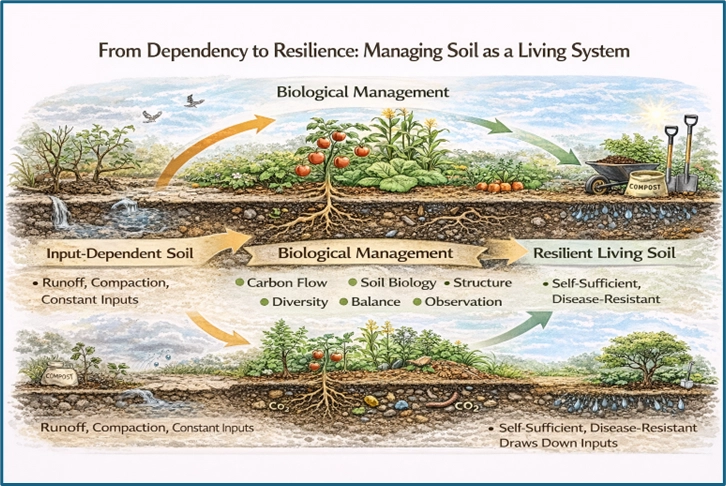
- How to recognize the early signs of soil decline
- Why some gardens become more input-dependent over time
- How disturbance and over-fertilization weaken soil resilience
- How living soil naturally suppresses disease and stress
- What simple practices rebuild soil function
- How to match soil management to plant type
- How to prevent long-term exhaustion
You will gain skills
- Seeing soil as a living system rather than a growing medium
- Diagnosing problems before they become severe
- Distinguishing between structural, biological, and fertility issues
- Making management decisions based on process, not products
- Designing garden beds that improve with age instead of decline
You will learn how to prevent 5 common patterns of soil decline
- Alienation: Recognizing when plants lose contact with beneficial soil microbes.
- Breakdown: Understanding how soil structure weakens and how to protect it.
- Compaction: Preventing loss of air and water movement in the root zone.
- Dependency: Reducing reliance on constant fertilizer and chemical inputs.
- Exhaustion: Avoiding long-term loss of organic matter and biological capacity.
Why Soil Is Alive (and Why That Matters)
Soil is not simply a material.
It is a living biological ecosystem.
This section explains what makes soil alive, how that life functions, and why it directly affects plant health and management decisions.
Understanding soil as living biology changes how we think about:
- Fertility
- Structure
- Water movement
- Disease pressure
- Long-term sustainability
Use the three tabs below to explore this foundation in sequence.

What Makes Soil Alive
Soil contains a vast and active community of organisms.
In a healthy handful of soil, billions of organisms are present:
- Bacteria
- Fungi
- Protozoa
- Nematodes
- Arthropods and earthworms
These organisms are not passive inhabitants.
They are biological processors and structural engineers.
They:
- Break down organic matter
- Store and release nutrients
- Bind soil particles into aggregates
- Create channels for air and water
Soil is alive because these organisms are constantly active, interacting, and transforming their environment.
How Soil Life Supports Plants
Plants do not grow alone.
They grow in partnership with soil biology.
Living soil organisms:
- Cycle nutrients gradually and predictably
- Buffer plants from nutrient spikes and deficiencies
- Improve water infiltration and retention
- Support root architecture
- Compete with or suppress harmful organisms
- Biology makes soil more stable.
Healthy soil does not eliminate stress.
It improves a plant’s ability to recover.
Why This Changes Management
If soil is treated as inert material, management becomes:
Reactive
Product-based
Short-term
If soil is treated as living, management becomes:
- Preventive
- Process-focused
- Long-term
When biology is strong:
- Fertilizer dependence decreases
- Structure improves naturally
- Disease pressure often declines
When biology weakens:
- Inputs increase
- Resilience declines
- Stress symptoms become more frequent
Soil being alive is not just a scientific fact.
It determines whether a garden becomes self-regulating or input-dependent.
How Soil Slowly Breaks Down: The A–B–C–D–E Pathway of Decline
Soil decline is rarely dramatic at first.
It follows a recognizable pattern.
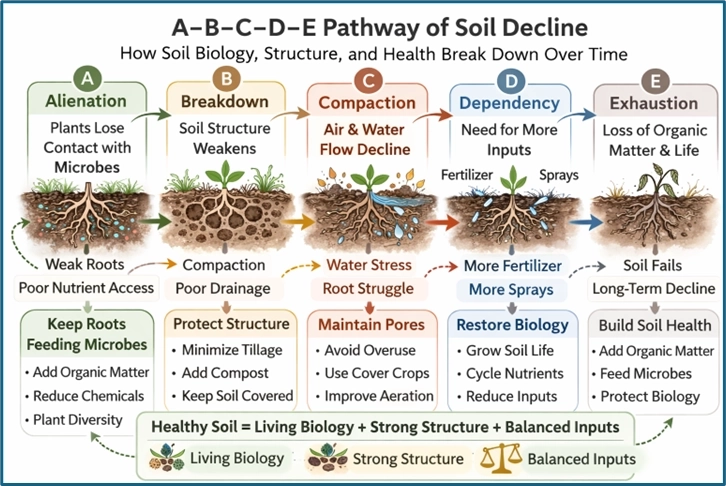
The A–B–C–D–E pathway is a simple framework for understanding how healthy soil gradually becomes input-dependent and exhausted.
This section defines that pathway, shows how it progresses, and explains how early recognition allows prevention.
Use the three tabs below to move through the pathway step by step.
The A–B–C–D–E Framework Defined
The pathway describes five recurring patterns of decline:
- A — Alienation
Plants lose connection with beneficial soil biology. - B — Breakdown
Soil structure weakens and aggregation declines. - C — Compaction
Pore space collapses, reducing air and water movement. - D — Dependency
Increasing reliance on fertilizers and external inputs. - E — Exhaustion
Long-term loss of organic matter and biological capacity.
These stages are not always linear, but they tend to reinforce one another.
The earlier the pattern is recognized, the easier it is to reverse.
How the Pathway Progresses
Decline often begins biologically.
When organic inputs decline or disturbance increases:
- Microbial diversity shrinks
- Fungal networks weaken
- Nutrient cycling slows
As biology weakens, structure follows:
- Aggregates destabilize
- Surface crusting increases
- Infiltration declines
Compaction further reduces oxygen and root growth.
Plants respond with stress symptoms.
Management then shifts toward increased inputs.
Over time, the system becomes less self-regulating and more reactive.
The pathway is gradual — but cumulative.
Why This Framework Matters
The A–B–C–D–E model is not meant to label soil as “bad.”
It is meant to:
- Help gardeners identify early warning signs
- Encourage preventive action
- Shift attention from symptoms to processes
Most gardens do not collapse suddenly.
They drift.
Recognizing where a soil system sits within the pathway allows:
- Targeted intervention
- Reduced input dependence
- Rebuilding before exhaustion
The goal is not perfection.
The goal is interruption of decline before it becomes entrenched.
How Fertilizers and Disturbance Can Accelerate Decline
Many common gardening practices appear helpful in the short term.
They loosen soil.
They stimulate growth.
They correct symptoms quickly.
But when used excessively, frequent disturbance and heavy soluble fertilization accelerate the A–B–C–D–E pathway of decline.
This section explains how these practices disrupt soil biology, increase dependency, and weaken long-term resilience — and how to adjust management without sacrificing plant performance.
Use the three tabs below to examine how decline is unintentionally accelerated.

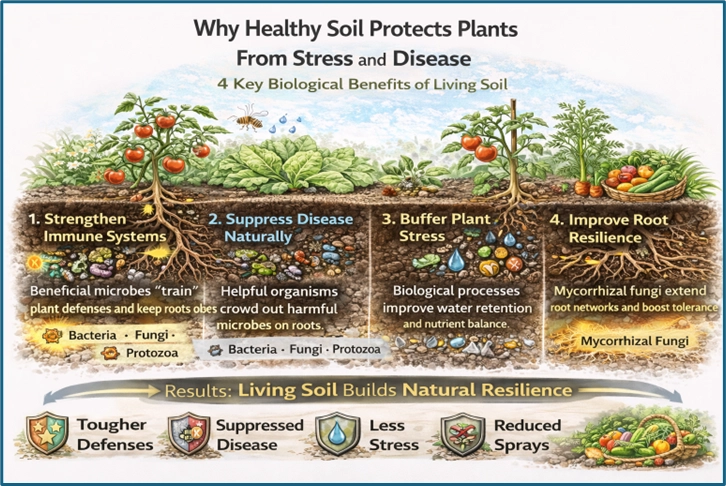
How Soil Microbes Strengthen Plant Defenses
Plants have immune systems.
But those systems function best when they receive continuous signals from beneficial soil organisms.
In biologically active soil:
- Roots communicate with bacteria and fungi
- Microbes stimulate defense pathways
- Plants remain alert without being stressed
- Response time to pathogens is faster
Beneficial microbes act like immune coaches.
They keep defense systems active at a low level, so when a real threat appears, plants respond quickly and efficiently.
In biologically weak soil, plants must react from scratch.
That delay often determines whether disease spreads.
Strong biology does not eliminate disease.
It improves response speed and recovery.
How Living Soil Suppresses Disease Naturally
Healthy soil actively resists pathogen invasion.
It does this through competition and occupation.
When beneficial organisms fill soil pores and root surfaces:
- Pathogens have fewer entry points
- Resources are limited
- Harmful microbes are crowded out
This is called natural disease suppression.
You rarely notice it working.
You notice it when it disappears.
In degraded soils:
- Root zones are poorly defended
- Pathogens find open niches
- Infections spread more easily
- Sprays become necessary
When biological diversity is high, disease pressure stabilizes.
When diversity declines, outbreaks become more common.
Why Stressed Plants Become Vulnerable
Stress weakens plant immunity.
When plants struggle with:
- Compaction
- Poor drainage
- Nutrient swings
- Drought
- Temperature extremes
They divert energy from defense to survival.
Stressed plants are vulnerable plants.
Living soil reduces stress by:
- Improving water regulation
- Stabilizing nutrient availability
- Enhancing root exploration
- Moderating temperature fluctuations
This gives plants the energy needed to resist infection.
Chemical controls often become necessary when biological defenses have already collapsed.
The need for constant spraying is often a soil problem first.
When soil biology strengthens:
- Minor infections fade
- Stress events are tolerated
- Recovery becomes faster
- Gardens become more predictable
Resilience is not created by a product.
It is created by a functioning system.
How Fertilizers and Disturbance Can Accelerate Decline
Plants do not resist stress and disease by accident.
Resilience emerges from stable relationships between roots, microbes, organic matter, water, and structure.
When soil biology is strong, plants are better prepared for:
- Drought
- Heat
- Nutrient swings
- Pathogen pressure
- Recovery after damage
This section explains how living soil strengthens plant defenses, suppresses disease naturally, and reduces long-term reliance on corrective treatments.
Use the three tabs below to explore how resilience is built from the ground up.
How Disturbance Disrupts Soil Life
Tilling, digging, and aggressive cultivation are often used to “improve” soil.
In the short term, they:
- Loosen compacted areas
- Mix in compost
- Control weeds
- Biologically, however, disturbance is disruptive.
Each time soil is turned:
- Fungal networks are broken
- Aggregates are shattered
- Microbial habitats are exposed
- Organic matter oxidizes rapidly
- Stored carbon is released
Disturbance interrupts the rebuilding process.
Occasional disturbance may be necessary.
Repeated disturbance prevents recovery.
When soil is constantly reset, the biological system cannot stabilize.
This accelerates:
- Breakdown
- Compaction
- Dependency
How Soluble Fertilizers Weaken Natural Cycling
Soluble fertilizers deliver nutrients directly to plant roots.
Growth often improves quickly.
But when nutrients are continuously supplied in readily available form:
- Roots release fewer exudates
- Microbes receive less energy
- Mycorrhizal partnerships weaken
- Natural nutrient cycling slows
Plants shift from ecosystem partners to nutrient consumers.
Over time:
- Biological activity declines
- Nutrients leach more quickly
- Greater fertilizer inputs are required
This deepens Dependency within the A–B–C–D–E pathway.
The system appears productive — but becomes increasingly fragile.
When “Helpful” Practices Become the Problem
Practices that appear beneficial in the short term can quietly accelerate decline when overused.
Over-fertilization and repeated disturbance often create a self-reinforcing loop:
More fertilizer → weaker biology → greater nutrient loss → more fertilizer
More tilling → broken structure → compaction → more tilling
Each cycle pushes soil further along the A–B–C–D–E pathway toward:
- Structural instability
- Biological simplification
- Input dependency
- Long-term exhaustion
Bare soil compounds the problem.
Without living roots or surface protection:
- Carbon inputs stop
- Microbial populations shrink
- Moisture evaporates faster
- Temperature fluctuates more dramatically
Decline accelerates quietly.
The solution is not eliminating fertility or tools.
It is shifting toward biological alignment:
- Minimal disturbance
- Moderate fertility
- Continuous plant cover
- Regular organic inputs
- Root diversity
These practices interrupt acceleration.
They keep soil in the resilient zone, rather than drifting toward the repair zone.
How to Rebuild Living Soil in Gardens
Soil health can be rebuilt at any stage.
Recovery does not require special products.
It requires supporting biological processes consistently over time.
Rebuilding focuses on restoring:
- Carbon flow
- Microbial habitat
- Root activity
- Structural stability
This section outlines the core practices that reliably move soil out of decline and back into resilience.
Use the tabs below to explore a practical restoration framework.

Keep Roots Growing and Soil Covered
Living roots are the foundation of soil recovery.
When plants are actively growing, they release carbon compounds that feed soil microbes.
When soil is bare, that food supply stops.
Bare soil is starving soil.
Gardens benefit from:
- Cover crops in unused beds
- Dense planting where appropriate
- Groundcovers under shrubs
- Perennials where possible
- Seasonal succession planting
Even short gaps in living cover slow biological rebuilding.
Surface protection matters as well.
Mulch and residues provide:
- Temperature moderation
- Moisture retention
- Carbon input
- Habitat stability
The goal is simple:
Keep carbon flowing into the soil as continuously as possible.
Feed the Soil, Not Just the Plants
Compost is not just fertilizer.
It is a biological support system.
High-quality finished compost provides:
- Organic matter
- Diverse microorganisms
- Slow-release nutrients
- Structural material
Best practices include:
- Applying thin layers (½ to 1 inch)
- Reapplying seasonally
- Avoiding thick, smothering layers
- Keeping compost off plant stems
Fertility should encourage biological partnerships, not replace them.
Biology-friendly fertility means:
- Moderate rates
- Slow-release sources
- Split applications when needed
- Avoiding nutrient floods
The goal is steady availability — not sudden abundance.
When nutrients move through organisms first, cycling becomes more reliable.
Minimize Disturbance and Build Diversity
Every time soil is turned, biological networks are disrupted.
Rebuilding accelerates when disturbance declines.
This does not mean “never dig again.”
It means dig intentionally.
- Avoid routine tilling
- Loosen only where necessary
- Preserve root channels
- Protect existing structure
Minimal disturbance allows microbes and fungi to rebuild stable habitats.
Diversity strengthens recovery.
Different plants feed different microbial communities.
Gardens benefit from:
Mixed plantings- Crop rotation
- Interplanting herbs and vegetables
- Combining annuals and perennials
Monocultures simplify biology.
Diversity stabilizes it.
Rebuilding soil is not complicated.
It is consistent application of:
- Continuous cover
- Carbon inputs
- Moderate fertility
- Minimal disruption
- Root diversity
Progress may feel slow.
But biological recovery begins before it becomes visible.
How to Maintain Healthy Soil for the Long Term
Rebuilding soil is only the first step.
Long-term success depends on protecting biological balance and avoiding a return to dependency.
Healthy soil does not stay healthy by accident.
It stays healthy through:
- Observation
- Moderation
- Protection during stress
- Continuous carbon flow
This section explains how to preserve resilience year after year.
Use the tabs below to learn how to maintain soil in the resilient zone.
Monitor Before You Modify
Many soil problems are created by overcorrection.
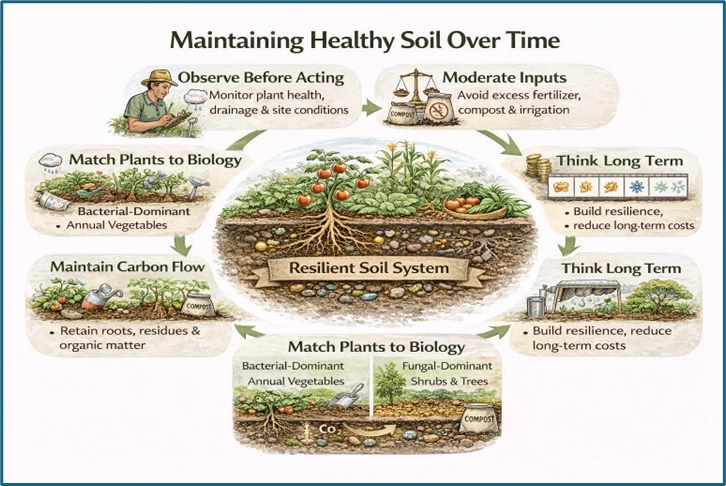
Before adding anything, observe:
- Is growth truly weak, or just seasonal?
- Is drainage poor everywhere, or localized?
- Has weather been extreme?
- Are symptoms widespread or isolated?
React slowly. Observe carefully.
Routine, automatic applications of fertilizer or amendments often restart the decline cycle.
Testing every few years is helpful.
But visible plant performance and site conditions matter just as much.
Healthy soil management is not autopilot.
It is intentional restraint.
Protect Gains During Stress
Stress events can undo years of improvement.
During drought, heavy rain, construction, or traffic:
- Reduce compaction
- Avoid working wet soil
- Maintain mulch coverage
- Keep irrigation moderate
- Avoid heavy fertilization
Biology is most vulnerable during stress.
Protecting soil during difficult periods preserves structure, carbon reserves, and microbial diversity.
Small protective actions prevent large setbacks.
Maintain Carbon Flow and Biological Match
Carbon drives soil biology.
Without continuous carbon inputs, decline quietly resumes.
Maintain carbon by:
- Leaving roots in place after harvest
- Chopping residues and returning them to the surface
- Using cover crops
- Applying compost seasonally
- Keeping soil covered year-round
Carbon is the currency of soil life.
When carbon flow slows, microbial activity declines.
When microbial activity declines, resilience weakens.
Match Soil Biology to Plant Type
Not all plants prefer the same biological balance.
In general:
- Annual vegetables and turf favor more bacterial-dominant systems
- Perennials, shrubs, and trees favor more fungal-dominant systems
This does not require lab measurements.
It requires aligning management with plant type.
Vegetable beds benefit from:
- Regular compost additions
- Seasonal turnover
- Faster nutrient cycling
Woody plant areas benefit from:
- Wood chip mulch
- Minimal disturbance
- Slower nutrient release
- Longer organic matter cycles
Alignment strengthens stability.
Misalignment restarts decline.
When carbon flows and biology matches plant needs:
- Fertilizer requirements decrease
- Stress tolerance improves
- Disease pressure stabilizes
- Gardens become more predictable
Long-term soil health is not about doing more.
It is about maintaining balance intentionally, season after season.